
A blueberry bush is one of the calmest fruit plants you can grow.
It flowers in spring, bears fruit in summer and often turns warm colors in fall.
With good care, a single planting can keep producing for 25 years or more.
The catch is the soil.
Blueberries need soil that is acidic, well drained, loose and rich in organic matter.
Most yards do not start out that way, so much of the work happens before planting.
This guide follows the blueberry fact sheet from Clemson Cooperative Extension.
It covers blueberry types, soil, planting, feeding, pruning and harvest.
Three Kinds of Blueberries
Clemson Extension describes three main types of cultivated blueberries for the Southeast.
- Rabbiteye blueberries, the most adaptable, productive and pest-tolerant of the three.
- Southern highbush blueberries, hybrids that handle summer heat and need fewer cold hours.
- Northern highbush blueberries, which suit colder regions better than the South.
Rabbiteye types are largely self-incompatible.
That means you need at least two different varieties planted near each other for good cross-pollination.
Southern highbush types are mostly self-fertile.
Even so, they give larger and earlier berries when several varieties grow together.
Chilling hours
Each variety needs a certain number of winter hours below 45 °F to flower well.
These are called chilling hours.
In South Carolina, they range from about 1,000 to 1,200 hours in the upper Piedmont.
Near the coast, they drop to about 400 to 600 hours.
Choose varieties whose chilling needs match your area.
Your local Extension office can tell you the typical range where you live.
Dwarf types for containers
Some compact hybrid blueberries grow only 2 to 4 feet tall.
They suit large containers on a sunny patio.
Place the containers in full sun for the best flowers and fruit.
Our guide to growing food in containers covers pots, drainage and daily watering.
Start With a Soil Test
Have the soil tested in fall, before planting in late winter or early spring.
Our guide to taking a garden soil sample explains how.
Clemson Extension gives clear limits for the result.
- If the pH is above 6.0, choose another planting site.
- If it is between 5.5 and 6.0, apply wettable sulfur to bring it down.
- Apply sulfur at least three months before planting, since it works slowly.
- Check the pH once or twice during the first season.
Some soils are very high in manganese.
On those soils, keep the pH above 5.0 to avoid manganese toxicity.
Our guide to raising or lowering soil pH explains how sulfur works.
Build Up Organic Matter
Blueberries are adapted to soils with 3 percent or more organic matter.
Most garden soils have less than 1 percent.
So Clemson Extension recommends mixing in organic matter when soil has less than 2 percent.
Good choices include peat moss, composted pine bark and rotted softwood sawdust.
Avoid fresh softwood sawdust that has not broken down yet.
A simple preparation plan
- On poorly drained soil, build mounds or ridges about 3 feet wide.
- Spread 4 to 6 inches of organic matter over a band 18 to 24 inches wide.
- Mix it in well, 6 to 8 inches deep.
- Do this in fall, and add any needed sulfur at the same time.
Pure organic material is not the goal.
Plants growing in it are hard to water and feed, and they often struggle.
Plan for Drainage
Blueberry roots dislike sitting in water.
On heavy clay or soil that stays wet, plant on a raised mound or ridge.
Clemson Extension suggests making it at least 6 inches above the surrounding soil.
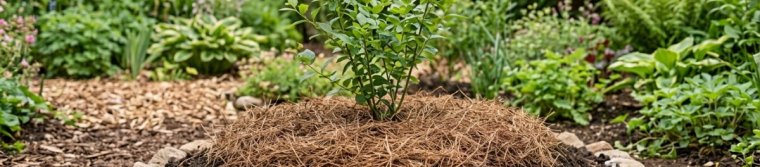
Logs, stones, bricks or concrete blocks can hold the raised soil in place.
Raised plantings dry out faster than flat ones.
Water them thoroughly two to three times a week during dry summer spells.
Planting
When to plant
Plant bare-root bushes in late winter, as soon as the soil can be worked.
Potted plants can also go in during fall.
What to buy
Two- or three-year-old plants, 1 to 3 feet tall, transplant well.
Keep the roots moist at all times until they are in the ground.
Spacing
- Southern highbush: 4 to 5 feet apart in the row, with rows 8 to 10 feet apart.
- Rabbiteye: 6 feet apart in the row, with rows 10 to 12 feet apart.
Depth and first cuts
Plant at the same depth the bush grew in the nursery or pot.
Firm the soil lightly and water thoroughly.
Then remove the shoot tips that carry plump, rounded flower buds.
Clemson Extension also advises cutting back the top growth at planting.
Remove about two thirds on bare-root plants and about one half on potted ones.
Avoid cuts near the base, which can let in stem blight.
Mulch Well
After planting, spread 2 to 3 inches of organic mulch.
Pine bark, pine straw, wood chips and sawdust all work.
Pine materials are naturally acidic and suit blueberries especially well.
Add about 1 inch of fresh mulch each year to keep weeds down.
Blueberry roots grow close to the surface.
So pull weeds by hand, and never hoe deeper than about 1 inch.
Our guide to mulching garden beds covers materials and depth.
Be Patient With the First Crops
It feels strange, but Clemson Extension advises removing all flower buds in the first two years.
Fruit takes a lot of energy from a young plant.
Without that load, the bush builds strong roots and shoots instead.
Let a small crop form in the third year.
Expect about half a pound per bush in year three and 1 to 2 pounds in year four.
Mature Southern highbush bushes can produce more than 8 pounds a year.
Mature rabbiteye bushes can produce 12 to 25 pounds.
Feed Gently
Blueberries are easily harmed by too much fertilizer.
Wait until the first leaves are full size before feeding a new plant.
Then use a small amount of azalea-type fertilizer in a circle about 12 inches from the stem.
Clemson Extension suggests 1 tablespoon per plant, repeated about every six weeks into midsummer.
In the second year, double the amount and widen the circle to 18 inches.
For bearing plants, apply about 1 cup in spring within a circle 3 feet from the plant.
Stop feeding bearing plants after the first of July.
Allow about 4 inches of rain or irrigation between applications.
Prune for New Wood
Blueberries fruit on wood that grew the previous year.
So the goal of pruning is a steady supply of strong new shoots.
- In the first years, remove low twiggy growth, dead shoots and weak, spindly stems.
- Tip back very long, floppy shoots so they branch and thicken.
- Prune young plants during the dormant season.
- Southern highbush types need pruning every year, ideally in late winter.
- Rabbiteye types need less pruning, since they carry heavy crops well.
Once a bush grows too tall to pick easily, remove about one third of the older canes in winter.
Opening the center lets light in and makes room for new canes.
Our guide to pruning shrubs explains thinning cuts in more detail.
Common Problems
Clemson Extension lists leaf spots, fruit rots, root rot and gray mold as possible diseases.
Insect pests include cranberry fruitworm, stem borers, Japanese beetles and yellownecked caterpillars.
Yellownecked caterpillars feed in groups and can strip stems quickly.
Check the leaves often during summer.
Birds are the most common thief of all.
Netting draped over the bushes or held on a frame is the only practical protection.
Harvest
Fruit ripens over about two months after bloom.
Pick Southern highbush berries every five to seven days.
Rabbiteye berries taste better when picked less often, about every 10 days.
That gives the fruit time to sweeten fully, with few soft berries.
A Bonus for Pollinators
Blueberry flowers also feed bees in early spring.
Rabbiteye blueberry appears on Clemson's list of native shrubs that attract pollinators.
Our guide to starting a pollinator garden shows how to plan blooms for every season.
A Simple Blueberry Checklist
- Choose varieties that match your chilling hours.
- Plant at least two rabbiteye varieties for cross-pollination.
- Test the soil in fall and keep the pH at 5.5 or a little below.
- Mix in organic matter where soil has less than 2 percent.
- Plant on a mound at least 6 inches high in wet or heavy soil.
- Remove all flower buds for the first two years.
- Mulch 2 to 3 inches deep and hoe no deeper than 1 inch.
- Feed lightly and stop after early summer.
- Prune each winter to keep new wood coming.
- Cover ripening fruit with netting.
A Calm Way to See It
Blueberries ask for patience at the start.
Prepare the soil, skip the first crops and prune a little each winter.
In return, the bushes can feed you for decades.
Sources and Further Reading
- Clemson Cooperative Extension, Home and Garden Information Center — Blueberry: supports the blueberry types, chilling hours, soil pH limits, organic matter, drainage, planting time, spacing, first-year cuts, mulch, feeding rates, pruning, problems, bird netting, yields and harvest timing.
- Clemson Cooperative Extension — How to Change Soil pH: why sulfur lowers pH slowly and why acid-loving plants need lower pH.
- Clemson Cooperative Extension — Soil Testing: how to test soil before planting.
- Clemson Cooperative Extension — Pollinator Gardening: rabbiteye blueberry as a native shrub for pollinators.