
A newly planted shrub or tree looks settled the moment the mulch goes down.
Below the surface, though, its real work has only begun.
For months, the roots must reach out from the root ball into the soil around it.
Until they do, the plant depends almost entirely on you for water.
Clemson Cooperative Extension notes that many new plants die from too little or too much water early on.
Most of those losses happen in the first few months after planting.
This guide follows the watering shrubs and trees fact sheet from Clemson Extension.
It covers care before planting, the first weeks after planting and a simple hand test for moisture.
What Established Means
An established plant has grown enough roots to stay alive without irrigation.
During establishment, roots spread out into the landscape soil.
Meanwhile, shoots and trunk grow more slowly than they did in the nursery.
That slower top growth is normal.
Regular watering in loose soil helps build a wide root system.
That root system is the plant's best defense against future droughts.
Before Planting: Keep Root Balls Moist
Sometimes a plant cannot go in the ground on the day it arrives.
Keep it in a shaded spot, sheltered from wind.
Keep watering it as often as the nursery did.
Container plants
Container-grown shrubs and trees dry out very quickly.
Clemson Extension warns that even one day without water can kill many roots.
Several days without water can kill the whole plant.
In warm weather, water them daily.
During hot, dry spells, they may need water twice a day.
In cooler weather, every other day may be enough.
Balled-and-burlapped plants
These plants are dug from a field with soil wrapped around the roots.
Freshly dug ones need more water than those that have been hardened off outdoors.
Surround the root balls with soil, compost, mulch or sawdust to slow drying.
Water slowly with a hose or sprinkler until the whole root ball is soaked.
Do not leave the root balls standing in water afterward.
Repeat as needed until planting day, based on heat and rain.
After Planting: The First Month Matters Most
The goal is steady moisture in the root ball, without saturation.
In well-drained soil, new shrubs and trees need daily watering for at least the first month.
Clemson Extension notes that frequent watering helps more than large amounts given rarely.
The right schedule is rarely the same from one site to the next.
Moisture in the root ball is what tells you whether it is working.
Aim at the root ball
New roots have not yet spread into the soil around the hole.
So water that lands far from the stem does little good at first.
Water slowly by hand with a hose, aiming at the root ball itself.
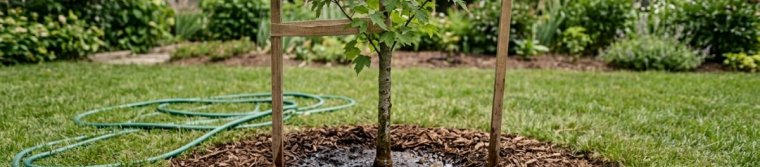
A temporary drip setup made just for the new plants also works well.
Too Little or Too Much
The type of soil decides which mistake is more likely.
Plants in well-drained soil tend to get too little water.
Plants in poorly drained soil tend to get too much.
Learn how your planting site behaves after rain and after watering.
Then aim for constant moisture in the root ball, never a soggy one.
Lawn Sprinklers Are Not Enough
Many yards rely on a system built to water the lawn and flower beds.
Clemson Extension explains why that causes trouble for new plants.
In well-drained soil, such a system cannot give new plants enough water.
Running it longer would overwater everything else and waste water.
Instead, water new shrubs and trees by hand or with their own temporary drip lines.
Poorly drained sites
In heavy soil near a watered lawn, the opposite problem appears.
Water runs across the surface and collects in the loose soil of the planting hole.
The roots can then drown.
Clemson Extension offers three ways around it.
- Plant new shrubs and trees in their own beds, away from lawn irrigation.
- Adjust the lawn system so it does not soak the new root balls.
- Plant slightly higher than the surrounding soil, so the top of the root ball stays out of standing water.
The second option may leave the lawn a little dry, so the first or third is often easier.
Adjust for Season and Soil
Plants set out in cooler weather may need less water.
Plants mounded above compacted or wet soil may need more.
A raised root ball dries out faster than one set level with the ground.
A plant set too deep in poorly drained soil is a special case.
Clemson Extension advises not watering it until it has been raised and replanted.
Our guides to planting a tree and planting a shrub show the right depth.
If you cannot water regularly after planting, consider smaller trees or shrubs.
Smaller plants establish more quickly than large ones.
What Happens When Watering Is Skipped
Root growth is slow on shrubs and trees that are not watered regularly.
Such plants often stay alive through normal weather.
When a drought arrives, though, they can die back.
Their small root system simply cannot reach enough water.
Steady watering in the first season is what prevents that later loss.
The Squeeze Test
Clemson Extension describes a simple test for the first week after planting.
- Wait several hours after watering.
- Gently dig a small hole in the loosened soil just outside the root ball, about half its depth.
- Take soil from the bottom of the hole and squeeze it in your palm.
Then read the result.
- Water drips between your fingers: you are watering too much.
- The soil crumbles and falls apart: you are watering too little.
- The soil holds together: moisture in the backfill is about right.
There is one more step.
Poke a finger into the root ball itself.
The soil around it can be fine while the root ball is bone dry.
If the root ball feels dry, increase the daily watering.
If you can squeeze water from it, it is too wet.
With a little practice, this check takes only a minute.
Mulch Helps Every Drop Count
A layer of organic mulch keeps soil moisture more even between waterings.
Spread it 2 to 3 inches deep over the planting area.
Keep it a few inches away from stems and trunks, since mulch against bark invites rot.
Our guide to mulching garden beds covers depths and materials.
A Simple Watering Checklist
- Keep plants shaded, sheltered and watered until planting day.
- Water container plants daily in warm weather.
- After planting in well-drained soil, water daily for at least the first month.
- Aim the water at the root ball, slowly and by hand.
- Do not rely on lawn sprinklers for new plants.
- In wet sites, plant slightly high and keep lawn water off new root balls.
- Use the squeeze test in the first week, then adjust.
- Check the root ball itself, not just the soil around it.
- Mulch 2 to 3 inches deep, away from the trunk.
A Calm Way to See It
The first months after planting are a short, careful season.
A few minutes a day with the hose builds roots that last for decades.
Once the plant is established, it will need far less of your help.
Sources and Further Reading
- Clemson Cooperative Extension, Home and Garden Information Center — Watering Shrubs and Trees: supports care before planting, daily watering for the first month, the problems with lawn irrigation, the three fixes for wet sites, seasonal changes and the squeeze test.
- Clemson Cooperative Extension — Planting Shrubs Correctly: watering the root ball in the first year and keeping mulch away from stems.
- Clemson Cooperative Extension — Planting Trees Correctly: planting depth and early care for trees.
- Clemson Cooperative Extension — Mulch: how mulch holds soil moisture.