
Stand by a patch of flowers on a sunny afternoon and the air starts to move.
Bees drift from bloom to bloom, a butterfly settles for a moment, and small flies hover nearby.
All of them are doing quiet, important work.
Clemson Cooperative Extension notes that about one third of the food on our plates is there because of pollinators.
A small pollinator garden gives these insects food and shelter close to home.
It can also help your own vegetables and fruit set a better crop.
This guide follows the pollinator gardening fact sheet from Clemson Extension.
It covers what pollination is, how to plan the garden, which plants to choose and how to give bees a place to nest.
What Pollination Is
Pollination is the movement of pollen from the male part of a flower to the female part.
The male part is called the anther, and the female part is called the stigma.
Pollen may move within the same plant or between two plants of the same species.
Good pollination is critical for many fruits and crops to develop.
More Than Honey Bees
Most people think of honey bees first.
Yet many other insects help, including native bees, beetles, flies, wasps and butterflies.
Clemson Extension points out that bees are an especially important group.
They gather pollen on purpose to feed their young.
On each trip they tend to visit the same kinds of flowers.
Along the way, they carry pollen from one bloom to the next.
What Pollinators Need
Like all living things, pollinators need food, shelter and water.
A good pollinator garden offers all three.
- Food: flowers that provide nectar and pollen from spring through fall.
- Shelter: places to nest and to spend the winter.
- Water: a clean source close by.
The rest of this guide takes each need in turn.
Step 1: Pick a Sunny Spot
Clemson Extension suggests starting with a sunny area of the yard.
Look at what is already there before you plant.
Note any existing nectar plants, nesting spots and wild corners.
A small bed, a border along a fence or a few large containers can all work.
If you grow vegetables or fruit, plant the pollinator garden nearby.
Clemson Extension notes that larger bees, such as bumble bees, travel farther than small ones like sweat bees.
Placing flowers close to your crops helps the smaller bees reach them too.
Step 2: Plan for Blooms in Every Season
Pollinators need food from early spring until fall.
Choose plants that flower at different times, so something is always in bloom.
Clemson Extension suggests starting with 8 to 10 plant species.
A wider mix of plants attracts a wider mix of insects.
Write down when each plant flowers and look for gaps in the calendar.
Fill those gaps over time with one or two new plants each season.
Step 3: Plant in Groups
Plant each kind of flower in a mass rather than one here and one there.
Clemson Extension suggests groups at least 3 feet wide when space allows.
Large patches are easier for insects to find.
They also let insects gather nectar and pollen more efficiently.
As a bonus, grouped flowers make a stronger display from the house.
Native Plants to Consider
The Clemson fact sheet lists many native plants that attract pollinators.
Here is a short selection, grouped by type.
Trees
- Eastern redbud, with pink flowers in spring.
- Serviceberry, with white flowers in spring.
- Flowering dogwood, with white flowers in spring.
- Sourwood, with white flowers in summer.
Shrubs
- Rabbiteye blueberry, with white flowers in spring.
- Virginia sweetspire, with white flowers in early summer.
- Oakleaf hydrangea, with white flowers in summer.
Perennials
- Wild columbine, red and yellow in spring.
- Butterfly weed, orange to red in summer.
- Purple coneflower, blooming from summer into fall.
- Black-eyed Susan, yellow from summer into fall.
- Showy goldenrod, yellow in late summer.
- Blue wood aster, blue from late summer into fall.
Vines
- Coral honeysuckle, red in spring and summer.
- Purple passionflower, purple in summer.
Warm-season annuals
- Zinnia, cosmos and sunflower.
- Spiderflower and Mexican sunflower.
- Basil, which also gives you leaves for the kitchen.
The Clemson list is written for South Carolina.
Your local Extension office can suggest native plants that suit your region.
Step 4: Leave Room for Nesting
Many native bees live alone rather than in hives.
Clemson Extension notes that solitary ground-nesting bees use bare patches of soil.
They prefer spots that are unmulched, well drained and in full sun.
So leave a small sunny area without mulch.
Other bees nest in wood.
They use rotting logs, stumps or twigs with soft, pithy centers.
A quiet corner with an old log or a few hollow stems can serve them well.
Making a simple nest box
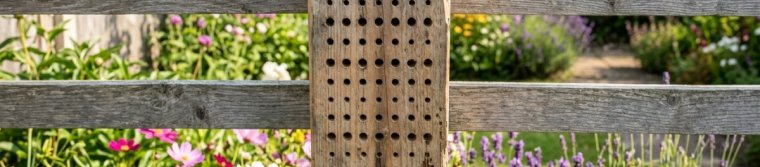
You can also offer wood-nesting bees a nest box.
Clemson Extension gives these guidelines:
- Use a block of untreated lumber.
- Drill holes between 3/32 and 3/8 inch wide, spaced three quarters of an inch apart from center to center.
- Keep the inside of each hole smooth, and leave one end closed.
- Make holes narrower than a quarter inch 3 to 4 inches deep.
- Make holes wider than a quarter inch 5 to 6 inches deep.
Mount the box 3 to 6 feet high in a sheltered spot.
A building wall, a fence or a tree all work, as long as the box gets morning sun.
Step 5: Add Water
Pollinators need water as well as flowers.
Keep a clean source close to the garden, such as a birdbath or a shallow dish.
Refresh it often so it stays clean.
Step 6: Spray Less
Pesticides can harm the very insects you are inviting.
Clemson Extension advises reducing pesticide use in the area around the garden.
If a product seems necessary, choose the least toxic option.
This applies to organic and synthetic products alike.
Apply it in the evening, when pollinators are less active.
Many pests can be handled gently first.
Our guide to aphids in the vegetable garden covers water sprays and helpful insects.
Our guide to insecticidal soap explains a gentle contact spray.
Herbs Help Too
Many kitchen herbs feed pollinators when they flower.
The Clemson herbs fact sheet notes that herbs are important nectar and pollen sources for bees, butterflies and hummingbirds.
Some, such as dill and fennel, also feed the caterpillars of swallowtail butterflies.
A few herb pots near the vegetable bed can serve both you and the bees.
Keep It Simple to Care For
A pollinator garden does not need to look formal.
Many native perennials come back each year with little care once they settle in.
Water new plants steadily during their first season.
Pull weeds while they are small so they do not crowd the flowers.
Leave a few seed heads and stems standing into fall, since some insects shelter in them.
A Simple Pollinator Garden Checklist
- Choose a sunny spot, ideally near your vegetables or fruit.
- Start with 8 to 10 plant species.
- Plan flowers from early spring through fall.
- Plant each kind in groups at least 3 feet wide.
- Favor native plants suited to your region.
- Leave a patch of bare, sunny soil for ground-nesting bees.
- Offer logs, pithy stems or a nest box for wood-nesting bees.
- Keep clean water nearby.
- Spray only when needed, choose the least toxic option and apply it in the evening.
A Calm Way to See It
A pollinator garden does not need to be large or perfect.
A sunny corner with a few groups of flowers is a real start.
Add a plant or two each season and watch which visitors arrive.
Sources and Further Reading
- Clemson Cooperative Extension, Home and Garden Information Center — Pollinator Gardening: supports what pollination is, the role of bees and other insects, site choice, 8 to 10 species, group planting, the native plant list, ground and wood nesting, nest box dimensions and reducing pesticide use.
- Clemson Cooperative Extension — Herbs: herbs as nectar and pollen sources and as food for swallowtail caterpillars.
- Clemson Cooperative Extension — Insecticidal Soaps for Garden Pest Control: a gentle option for soft-bodied pests.