
Most houseplant problems start small.
A few pale specks appear under a leaf, or the soil stays damp a little too long.
Caught early, these are usually easy to fix.
Caught late, they can mean a long recovery or even a lost plant.
A short weekly check is the calmest way to stay ahead.
For a small collection, it takes about ten minutes.
This routine follows the University of Maryland Extension, the University of California IPM program and the EPA.
Pick a regular day, make a cup of tea and walk slowly from plant to plant.
Step 1: Look at the Whole Plant From a Step Back
Start with a quiet look before you touch anything.
- Is the plant standing up, or are the stems drooping?
- Are the newest leaves a healthy color and size?
- Are the lower leaves yellowing or dropping?
- Is the plant leaning hard toward the window?
A plant that leans toward the light grows more evenly with a gentle quarter turn each week.
New leaves tell you the most about how the plant feels right now.
Old leaves often show problems that started weeks ago.
Step 2: Check the Soil Before You Water
The University of Maryland Extension recommends watering by need, not on a fixed calendar.
Push a finger about two inches into the potting mix.
If it feels dry at that depth, most common houseplants are ready for water.
Lift the pot too, since a light pot is usually a dry pot.
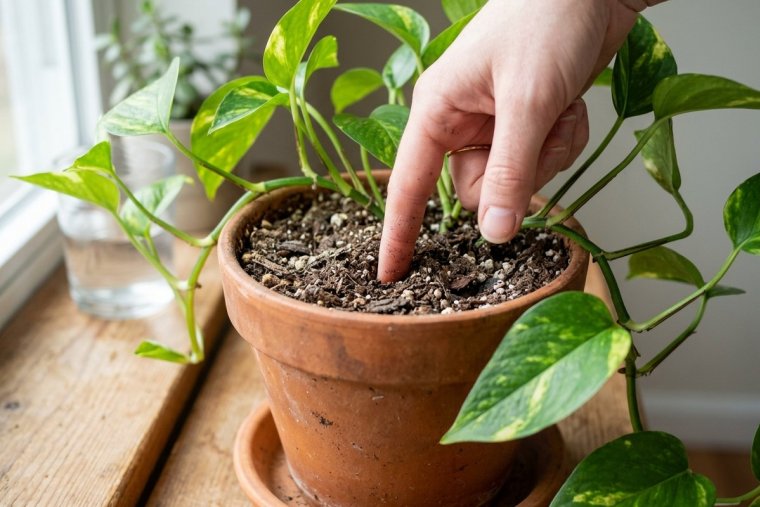
When you water, water slowly until it drains from the bottom.
Then empty the saucer.
The UMD Extension advises never letting a houseplant sit in water.
It also describes the two common watering signals.
- A thirsty plant wilts, and its leaves turn a dull grayish green.
- A plant kept too wet may drop leaves or turn yellow.
Our guide on how to water indoor plants walks through the full routine.
Step 3: Turn Over a Few Leaves
Many small pests hide on the undersides of leaves and along the stems.
Turn over three or four leaves on each plant, including one near the center.
- Tiny pale dots and fine webbing can point to spider mites.
- White, cottony tufts in leaf joints can be mealybugs.
- Sticky leaves or a sticky shelf often mean sap-feeding insects nearby.
- Small dark flies near the soil are often fungus gnats.
The UC Pest Notes on spider mites describe the light stippling on leaves and the fine webbing.
They also suggest shaking a leaf over white paper to spot tiny moving dots.
The UC Pest Notes on fungus gnats explain that the larvae live in moist potting mix.
That is one more reason to let the top of the mix dry between waterings.
Our guides to spider mites, mealybugs and fungus gnats explain the next steps.
Step 4: Look at the Soil Surface and the Pot
Next, glance at the top of the mix and the pot itself.
- A white crust on the mix can mean salt buildup.
- Fuzzy growth or a mushroom suggests the mix stays too wet.
- Water sitting in a saucer or cover pot should be poured out.
- Roots poking out of the drainage hole may mean the plant needs more room.
The UMD Extension lists brown leaf tips, lost lower leaves and a white crust as signs of salt buildup.
It suggests flushing salts out every four to six months.
A reminder on your calendar makes this easy to remember.
Our guides to brown leaf tips and mold around houseplants cover these signs in detail.
Step 5: Tidy Up
A few small chores keep problems from building up.
- Remove yellow or dead leaves and anything that has fallen onto the soil.
- Wipe dusty leaves with a soft, damp cloth.
- Wipe the saucer and the shelf under the pot.
The UC program notes that spider mite damage is usually worse in dusty conditions.
It is also worse on plants that are stressed for water.
So clean leaves and steady watering are quiet forms of pest prevention.
Our routine for cleaning houseplant leaves shows how to do it gently.
Step 6: Check the Room
Plants respond to the room as much as to the pot.
- Glance at a humidity meter if you have one.
- Wipe condensation from cold windows near plants.
- Move pots away from heating vents and cold drafts.
If you run a humidifier, the EPA guide to home humidifiers gives clear advice.
- Do not raise indoor humidity above 50 percent.
- Empty, dry and refill portable units every day.
- Clean portable humidifiers every third day.
Our guide to houseplants and dry winter air has more gentle ideas.
Step 7: Keep Simple Notes
A small notebook or a note on your phone turns the check into real knowledge.
- The date you watered each plant.
- Anything unusual you noticed.
- What you changed, one thing at a time.
After a few weeks, you will see each plant's rhythm.
You will know which ones drink fast and which ones prefer to stay a little dry.
What to Do When You Find Something
Stay calm, and start with the gentlest step.
- Move a plant with pests away from the others.
- Rinse or wipe pests off before reaching for any product.
- Change one thing at a time, then watch the new growth.
If you use any product, read the label and follow it exactly.
Keep products in their original containers, out of reach of children and pets.
New plants deserve an extra close look in their first weeks at home.
Our checklist for bringing home a new houseplant explains why.
A Calm Checklist
- Look at the whole plant, especially the newest leaves.
- Check the soil two inches down before you water.
- Water until it drains, then empty the saucer.
- Turn over a few leaves and look for specks, webbing and cotton.
- Look for crust, fuzz and standing water in the pot.
- Remove dead leaves and wipe off dust.
- Check humidity and keep it at or below 50 percent.
- Write down what you see and what you change.
Ten quiet minutes a week can save hours of rescue work later.
The check also becomes a small, calming ritual of its own.
Your plants will show you the difference in their new leaves.
Sources and Further Reading
- University of Maryland Extension — Watering Indoor Plants: supports watering by need, the two-inch finger test, the lift test, never leaving plants in water, the signs of too little and too much water, and flushing salts every four to six months.
- UC Statewide Integrated Pest Management Program — Pest Notes: Spider Mites: supports the stippling and webbing, the white paper check and worse damage in dusty conditions and on water-stressed plants.
- UC Statewide Integrated Pest Management Program — Pest Notes: Fungus Gnats: supports fungus gnat larvae living in moist potting mix.
- US EPA — Use and Care of Home Humidifiers: supports keeping humidity at or below 50 percent, daily refills and cleaning every third day.