
When the heat comes on for winter, the air inside a home can feel dry within days.
Lips crack, static snaps on the sweater, and some houseplants start to look tired.
Leaf edges curl, and new leaves seem slower to open.
It is tempting to fill the room with moisture for the plants.
But the air in a home is shared by people, plants, walls, and furniture.
Too much humidity invites mold, and that is a bigger problem than a crispy leaf tip.
This guide shows a calm middle path.
It relies on guidance from the Environmental Protection Agency and the University of Maryland Extension.
Why Winter Air Gets So Dry
Cold outdoor air holds little moisture.
When it comes inside and gets warmed by the heating system, its relative humidity drops.
The EPA lists common winter nuisances linked to dry heated air.
They include static electricity, peeling wallpaper, and cracks in paint and furniture.
Many popular houseplants come from humid places, so they feel that change too.
Know the Range That Keeps Your Home Healthy
Before adding moisture, it helps to know the target.
In its brief guide to mold and moisture, the EPA recommends keeping indoor humidity below 60 percent.
The ideal range it gives is between 30 and 50 percent.
Its guide to home humidifiers is even more specific.
It advises not humidifying above 50 percent, because higher levels may encourage mold and dust mites.
So the goal is modest: bring a dry room up into that range, not past it.
Step 1: Measure Before You Change Anything
A small humidity meter, called a hygrometer, takes the guesswork out.
The EPA notes that these meters are inexpensive and sold at many hardware stores.
Place one near your plants, away from heater vents and direct sun.
Check it at different times of day for a week.
You may find that your home is already within the healthy range.
If it is, focus on watering and placement instead of adding moisture.
Step 2: Move Plants Away From Heat and Cold
Placement often matters more than humidity alone.
- Keep plants out of the direct path of heater vents and radiators.
- Pull pots a few inches back from cold window glass on frosty nights.
- Avoid spots right next to doors that open to the cold.
A plant that is not blasted by hot or cold air copes much better with dry air.
Hot, dry spots can also favor spider mites.
The UC program’s Pest Notes on spider mites link them with hot, dusty conditions and water-stressed plants.
Step 3: Group Plants Together
Plants release moisture from their leaves.
When several plants sit close together, that moisture lingers around them a little longer.
Grouping is gentle and adds almost nothing to the humidity of the whole room.
Leave a small gap between leaves so air can still move.
Check the group often, since pests can travel more easily between touching plants.
Step 4: Try a Pebble Tray
A pebble tray adds a little local moisture without wetting the roots.
- Choose a shallow tray a bit wider than the pot.
- Fill it with a layer of pebbles or gravel.
- Add water until it sits just below the top of the pebbles.
- Set the pot on the pebbles, so the base stays above the water.
- Top up the water as it evaporates, and rinse the tray now and then.
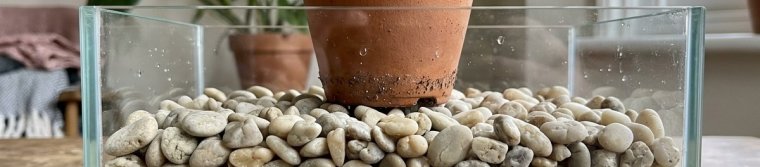
The important part is step 4.
The University of Maryland Extension is clear that houseplants should never sit in water.
Roots in standing water can stay soggy and suffer.
Step 5: Use a Humidifier Carefully
In a very dry home, a small humidifier can help both people and plants.
The EPA recommends using one only when conditions require it, and caring for it well.
- Empty the tank, wipe it dry, and refill portable units every day.
- Clean portable humidifiers every third day, following the maker’s directions.
- Use water with low mineral content, such as distilled water.
- Keep the area around the humidifier from becoming damp.
- Keep steam humidifiers out of reach of children, since steam can burn.
Place the humidifier near the plants, but not so close that leaves stay wet.
Keep your hygrometer in the same room, and stay at or below 50 percent.
Step 6: Watch for Signs of Too Much Moisture
The EPA points to condensation as a sign of high humidity.
- Water droplets forming on windows, walls, or pictures.
- A musty smell near the plants or the humidifier.
- Damp carpet, curtains, or tablecloths near the plant corner.
If you see condensation, the EPA suggests moving the humidifier, lowering its setting, or using it less.
Dry any wet surfaces quickly.
The same guide says damp areas dried within 24 to 48 hours usually do not grow mold.
Adjust Watering for Winter
The University of Maryland Extension notes that humidity and temperature both affect how fast potting mix dries.
It recommends watering when the plant needs it, not on a fixed schedule.
The simple test is to feel the soil to a depth of about two inches.
If it is dry, water until it drains from the bottom, then empty the saucer.
Our guide on how to water indoor plants covers that routine in detail.
Not Every Brown Tip Means Dry Air
Brown leaf tips are easy to blame on winter air.
The University of Maryland Extension lists another common cause: a buildup of soluble salts in the potting mix.
Other signs include a white crust on the soil, slow growth, and dropping lower leaves.
The fix there is flushing the pot with plenty of clear water every four to six months.
So before you add moisture, check the soil surface and the drainage hole too.
Keep Leaves Clean
Winter dust settles fast when windows stay closed.
A gentle wipe or rinse keeps leaves clear and helps you spot pests early.
Our guide on how to clean houseplant leaves shows a calm routine.
A Calm Way to Think About It
Most houseplants do not need a tropical room to get through winter.
They need steady care, a spot away from hot and cold drafts, and air in a sensible range.
Measure first, add moisture gently, and keep an eye on the windows.
Your plants and your home will both stay healthier that way.
Sources and Further Reading
- US Environmental Protection Agency — A Brief Guide to Mold, Moisture and Your Home: supports keeping humidity below 60 percent, ideally 30 to 50 percent, hygrometers, condensation as a warning sign, and drying wet areas within 24 to 48 hours.
- US Environmental Protection Agency — Use and Care of Home Humidifiers: supports winter dryness nuisances, staying at or below 50 percent, daily emptying, cleaning every third day, low-mineral water, and steam safety.
- University of Maryland Extension — Watering Indoor Plants: supports watering by need, the two-inch test, never letting plants sit in water, and soluble salt symptoms and flushing.
- UC Statewide Integrated Pest Management Program — Pest Notes: Spider Mites: supports the link between hot, dusty conditions, water stress, and spider mites.