
A houseplant can look healthy from across the room.
Up close, the tips of some leaves are brown, dry and crisp.
It is one of the most common worries people have about indoor plants.
Brown tips rarely mean a plant is about to die.
They are more like a note from the plant about water, salts or air.
This guide helps you read that note calmly, one possible cause at a time.
It follows the University of Maryland Extension, the University of California IPM program and the EPA.
First, Look at the Pattern
Before you change anything, take a slow look at the whole plant.
The pattern of the damage often points to the cause.
- Only the tips and edges are brown, and new leaves look fine.
- Older, lower leaves are browning or dropping off.
- Leaves are dotted with tiny pale specks, with or without fine webbing.
- Leaves are yellow or dull, and the plant wilts while the soil is still wet.
- A white crust sits on top of the potting mix.
Write down what you see, or take a photo.
Then compare it with the causes below.
Change one thing at a time, so you can tell what actually helped.
Cause 1: Salt Buildup in the Pot
Tap water and fertilizer both carry dissolved minerals, often called soluble salts.
The water leaves the pot, but some of those salts stay behind.
Over months, they can build up in the potting mix.
The University of Maryland Extension lists the signs of salt buildup.
- Brown leaf tips.
- Loss of lower leaves.
- Dead root tips.
- A white crust on the surface of the potting mix.
If your plant shows several of these together, salts are a strong suspect.
Plants that are fed often, or that have not been repotted in a long time, are the usual candidates.
How to Flush Salts Out
The UMD Extension recommends a simple routine called leaching.
- Gently scrape off any crust on top of the mix.
- Take the plant to a sink or a tub.
- Slowly pour clear water through the pot, about twice the volume of the pot.
- Let it drain completely before you put the plant back in its place.
The UMD Extension suggests leaching every four to six months.
It also advises leaching before you fertilize, so you do not rinse away fresh plant food.
If a pot drains poorly and salts keep returning, it recommends repotting.
It even suggests leaching every new plant at its first watering at home.
Our guide to bringing home a new houseplant covers that first week.
Check the Water You Use
The kind of water you pour matters too.
The UMD Extension advises against softened water for houseplants.
Softened water contains more dissolved minerals.
It mentions rainwater or water collected from a dehumidifier as alternatives.
If you use tap water, let it stand for a day before watering.
The UMD Extension also suggests leaving the last inch or two of water in the container unused.
Cause 2: Too Little Water
A plant that dries out too far can also brown at the tips.
The UMD Extension describes a thirsty plant as wilted, with leaves that turn a dull grayish green.
Check the soil before you decide.
- Push a finger about two inches into the mix.
- If it is dry at that depth, most common houseplants are ready for water.
- Lift the pot, since a light pot is usually a dry pot.
When you water, water slowly until it drains from the bottom, then empty the saucer.
The UMD Extension recommends watering by need rather than on a fixed schedule.
Our guide on how to water indoor plants walks through the full routine.
Cause 3: Too Much Water
It sounds strange, but soggy soil can also damage leaves.
The UMD Extension notes that a plant that is too wet may drop leaves or turn yellow.
Roots that sit in wet mix for long periods cannot get the air they need.
Damaged roots cannot supply water well, so the leaves suffer even in damp soil.
If the plant wilts while the soil is still moist, check the roots.
Our calm guide to root rot shows how to do it.
Our guide to yellow leaves helps you tell the two watering problems apart.
Cause 4: Very Dry Indoor Air
Winter heating can make indoor air feel very dry.
Dry air is often blamed for brown tips, so it is worth ruling out salts and watering first.
The UMD Extension notes that humidity and temperature both affect how much water a plant uses.
A hygrometer from a hardware store tells you the real humidity in a room.
If you use a humidifier, the EPA gives clear advice in its guide to home humidifiers.
- Do not raise indoor humidity above 50 percent.
- Empty, dry and refill portable units every day.
- Clean portable humidifiers every third day.
- Use water with low mineral content, such as distilled water.
- If water condenses on windows or walls, turn the humidifier down or move it.
The EPA explains that higher humidity can encourage dust mites and mold in the home.
Our guide to houseplants and dry winter air has more gentle ideas, such as grouping plants together.
Cause 5: Tiny Pests Under the Leaves
Sometimes the damage is not true tip burn at all.
The UC Pest Notes on spider mites describe a stippling of light dots on the leaves.
Leaves sometimes take on a bronze color, then turn yellowish and drop.
Fine webbing on the leaves is a strong clue.
- Turn a few leaves over and look closely, ideally with a hand lens.
- Shake a leaf over a sheet of white paper and watch for tiny moving dots.
- Check plants near a warm, sunny window first.
The UC program notes that mite damage is usually worse on water-stressed plants and in dusty conditions.
So steady watering and clean leaves help prevent trouble.
Our guides to spider mites and thrips explain what to do next.
Our routine for cleaning houseplant leaves helps keep dust down.
What to Do With Leaves That Are Already Brown
Brown, dry tissue will not turn green again.
That is fine, because the green part of the leaf keeps working.
- If the look bothers you, trim only the brown part with clean, sharp scissors.
- Follow the natural shape of the leaf as you cut.
- Leave a very thin edge of brown so you do not cut into healthy tissue.
- Remove leaves that are mostly brown or yellow, cutting near the base.
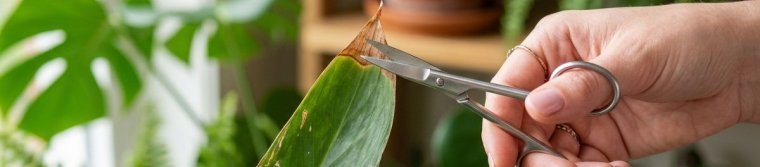
Then watch the new leaves over the next few weeks.
If they come in clean, the change you made is working.
A Calm Checklist
- Look at the pattern before you change anything.
- Check for a white crust and flush salts every four to six months.
- Avoid softened water and let tap water stand for a day.
- Water by need, using the two-inch finger test.
- Check the roots if the plant wilts in wet soil.
- Measure humidity and keep it at or below 50 percent.
- Look under the leaves for specks and webbing.
- Trim brown tips neatly and watch the new growth.
Brown tips are a small signal, not a verdict.
With a patient look and one change at a time, most plants settle down.
Soon the new leaves will tell you that you found the cause.
Sources and Further Reading
- University of Maryland Extension — Watering Indoor Plants: supports the signs of salt buildup, leaching every four to six months with twice the pot volume, avoiding softened water, letting tap water stand, signs of too little and too much water, and watering by need.
- UC Statewide Integrated Pest Management Program — Pest Notes: Spider Mites: supports the stippling, bronzing and yellowing of leaves, webbing, the white paper check, and worse damage on water-stressed plants.
- US EPA — Use and Care of Home Humidifiers: supports keeping indoor humidity at or below 50 percent, daily refills, cleaning every third day and using low-mineral water.