
When a tree or shrub looks a little pale, a bag of fertilizer can seem like the obvious fix.
Yet feeding a plant that does not need it rarely helps.
Sometimes it even does harm.
Clemson Cooperative Extension makes a calm point that surprises many gardeners.
Mature trees and shrubs growing in good soil need little or no fertilizer.
When feeding does make sense, a few simple rules make it work.
This guide follows the fertilizing trees and shrubs fact sheet from Clemson Extension.
It covers when to feed, what to use, where to spread it and how much is enough.
Feed With a Reason
Clemson Extension says fertilizer should be used with a clear goal, not as a yearly habit.
It lists a few good reasons to fertilize:
- A soil test or plant tissue test shows a nutrient is lacking.
- You want to encourage growth in a young tree that is already established.
- An older tree grows where fallen leaves are always removed, so nutrients are not recycled.
- Fruit and nut plants, such as blueberries and figs, need the nutrients that the harvest removed.
If none of these fit, your tree or shrub may be fine without any fertilizer.
When Pale Leaves Are Not Hunger
Light green leaves, short new shoots and fewer flowers can have many causes.
Clemson Extension warns against assuming fertilizer will fix them.
Roots damaged by pests, drought or too much water cannot take up nutrients well.
A soil pH that is too low or too high can also lock nutrients away.
Adding more fertilizer will not help until the pH is back in range.
Our guide to taking a garden soil sample shows how to find out.
A soil test report lists the pH, the nutrient levels and how much fertilizer to apply.
It tells you what is low, but not why, so look at roots and watering too.
The Four Rs
Once you know a plant needs nutrients, Clemson Extension recommends the four Rs:
- The right kind of fertilizer.
- In the right place.
- In the right amount.
- At the right time.
Following them helps roots take up more and lets less wash away into streams and groundwater.
The Right Kind
Reading the three numbers
Every fertilizer bag shows three large numbers.
They stand for nitrogen, phosphorus and potassium, often written as N-P-K.
Each number is a percent of the bag weight.
So a 30-pound bag of 12-4-7 holds 3.6 pounds of nitrogen.
The rest is mostly carrier material that helps spread the nutrients evenly.
The ratio trees and shrubs prefer
Clemson Extension notes that landscape trees and shrubs generally prefer a ratio of 3:1:1 or 3:1:2.
If your soil test does not call for phosphorus, a ratio such as 3:0:1 fits better.
To find a ratio, divide each number by the smallest one.
For example, a 16-4-8 fertilizer has a ratio of 4:1:2.
Slow-release is the calmer choice
Clemson Extension recommends slow-release nitrogen fertilizers for woody plants.
Ideally, one third to one half of the nitrogen should be in a slow-release form.
It feeds the roots gradually and is less likely to run off or leach away.
The Right Amount
Fertilizer rates for trees and shrubs are based on nitrogen.
It is the nutrient plants need most, and it has the biggest effect on growth.
The tree care industry standard cited by Clemson Extension gives these yearly limits:
- Slow-release nitrogen: 2 to 4 pounds of nitrogen per 1,000 square feet a year, and never more than 6.
- Fast-release nitrogen: 1 to 2 pounds of nitrogen per 1,000 square feet, and never more than 4 a year.
These numbers refer to the nitrogen itself, not the total weight of the product.
Your soil test report usually turns this into a simple rate for one fertilizer.
Too much fertilizer can burn or even kill plants.
Extra nitrogen also pushes soft, leafy growth that suffers more from cold, drought and pests.
Fertilizer the roots cannot absorb can end up in groundwater and nearby streams.
The Right Place
Most of the roots that absorb water and nutrients are fine, short-lived feeder roots.
They spread through the root zone under the canopy.
That zone runs from just outside the base of the trunk to the tips of the outermost branches.
This outer edge is often called the drip line.
Spread the fertilizer evenly over that whole area, not in a pile at the trunk.
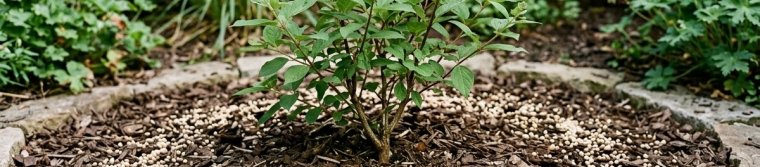
Apply it the same way whether the ground is bare or covered with mulch.
Narrow and closely planted trees
Columnar trees have narrow crowns and smaller root zones.
For these, Clemson Extension suggests measuring the trunk diameter in inches, 4 and a half feet above the ground.
Multiply that number by 1 or 1.5 to get the radius of the feeding area in feet.
A trunk 12 inches across gives a feeding radius of 12 to 18 feet.
When shrubs or trees grow close together, treat the whole group as one canopy.
The Right Time
Trees and shrubs take up fertilizer while they are actively growing.
That runs from when new growth starts in spring until late summer and early fall.
Clemson Extension suggests feeding in spring to early summer, and again in late summer to early fall.
Late-season feeding reaches roots that are still growing after the shoots have stopped.
Split the yearly amount into a few smaller doses instead of one large one.
Smaller doses are more likely to be used by the plant and less likely to wash away.
This matters most in sandy soil.
Avoid feeding trees and shrubs that are stressed by drought in summer.
Roots need moist soil to take up nutrients.
Some shrubs, such as azaleas and hydrangeas, push several flushes of growth each season.
For these, apply only part of the yearly amount late in the season.
How to Apply It
Clemson Extension calls broadcasting granular fertilizer over the root zone an economical and effective method.
A drop spreader or a broadcast spreader helps you spread it evenly.
Follow the directions on the fertilizer label.
Apply it when the leaves of shrubs and ground covers are dry.
Fertilizer granules resting on leaves can draw out moisture and scorch them.
Brush off any granules caught in the leaves with a leaf rake or broom.
Water soon after you apply it.
Watering washes fertilizer off the leaves and helps nutrients move through the mulch to the roots.
Do not add extra just because mulch or ground covers sit on top of the soil.
Trees in a Fertilized Lawn
Tree and shrub roots spread well beyond the trunk and under the lawn.
They pick up nutrients from the fertilizer you give the grass.
Clemson Extension notes that trees in a fed lawn may need no extra fertilizer at all.
Watch the trees, and add more only if they show a real need.
New Plantings Need Water First
For a newly planted tree or shrub, water matters far more than fertilizer.
Clemson Extension calls water the most important element for a successful start.
Add fertilizer at planting only when a soil test shows the soil lacks nutrients.
Our guide to planting a tree the right way covers watering a new tree.
A Simple Feeding Checklist
- Ask why the plant needs feeding before you buy fertilizer.
- Test the soil, and correct the pH first if needed.
- Choose a slow-release fertilizer, often near a 3:1:1 or 3:1:2 ratio.
- Stay within the yearly nitrogen limits.
- Spread it evenly out to the drip line.
- Feed in spring to early summer and late summer to early fall.
- Split the yearly amount into smaller doses.
- Apply when leaves are dry, then water it in.
A Calm Way to See It
Many healthy trees and shrubs live for decades with little or no fertilizer.
When feeding is truly needed, a measured amount at the right time does the job.
Good mulch also helps, and our guide to mulching garden beds shows how.
Sources and Further Reading
- Clemson Cooperative Extension, Home and Garden Information Center — Fertilizing Trees and Shrubs: supports the reasons to fertilize, the four Rs, reading the fertilizer label, preferred ratios, slow-release nitrogen, yearly nitrogen limits, the root zone and drip line, timing, application methods, lawns and new plantings.
- Clemson Cooperative Extension — Soil Testing: how to collect a sample and read the report.
- Clemson Cooperative Extension — Changing the pH of Your Soil: why pH must be corrected before fertilizer can help.