
When people bring home a new plant, they usually think about light and water first.
The pot often gets chosen for its color.
Yet the pot quietly decides how long the roots stay wet.
A good pot will not fix every problem, but a poor one can cause several.
This guide explains what to look for in a houseplant pot, from the drainage hole to the saucer.
It follows the University of Maryland Extension and the University of California Statewide Integrated Pest Management Program.
Why the Pot Matters So Much
Roots need both water and air.
When potting mix stays soaked, the small spaces that should hold air fill with water.
The UC Pest Notes on Phytophthora root and crown rot explain that long soaking reduces oxygen in the soil.
That makes even healthy plants more open to root rot.
The UC program notes that root rot can develop after as little as 4 to 8 hours of soil saturation.
So the main job of a pot is to let extra water leave.
Rule 1: Choose a Pot With a Drainage Hole
This is the single most important feature.
The University of Maryland Extension recommends watering until water runs out of the bottom.
It also says never to let a houseplant sit in water.
That routine only works if the water has somewhere to go.
- Turn the pot over in the store and look for at least one hole.
- Make sure the hole is not covered by a sticker or a plastic disk.
- After the first watering, check that water actually runs out of the hole.
If you fall in love with a pot that has no hole, you can still use it.
Use it as a cover pot, as described below.
Rule 2: Use a Cover Pot the Smart Way
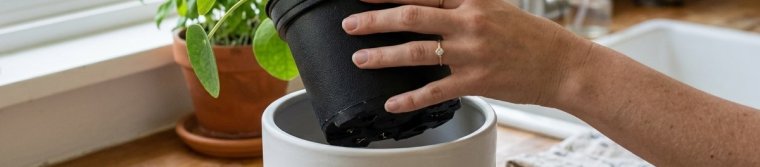
Many decorative pots are meant to hold a plain plastic nursery pot inside them.
This setup is called a cover pot or cachepot.
- Keep the plant in its plastic pot with drainage holes.
- Set that pot inside the decorative one.
- To water, lift the plastic pot out and water it in the sink.
- Let it drain fully before you set it back.
- A little later, check the bottom of the cover pot and pour out any water.
Water hidden in a cover pot is easy to forget.
It is also exactly the standing water the UMD Extension warns against.
Rule 3: Empty the Saucer
A saucer protects your furniture, and it is good to have one.
The problem starts when water stays in it.
The UMD Extension says to empty the saucer after the pot has drained.
A wet saucer and soggy mix also invite small visitors, such as springtails and fungus gnats.
If pets live with you, an empty saucer is also one less place for them to drink from.
Rule 4: Pick a Sensible Size
It is tempting to buy a large pot so the plant can grow into it.
A very large pot holds much more potting mix than the roots can use.
That extra mix can stay wet long after the roots have taken what they need.
For most houseplants, a pot only a little wider than the root ball is easier to manage.
Move up to a slightly larger pot when the plant truly needs more room.
The UMD Extension offers one useful clue.
If your finger cannot go two inches into the mix, the plant may be root bound.
The mix may also need to be more porous.
Clay, Plastic or Glazed?
Each common material behaves a little differently.
- Unglazed clay lets some water and air pass through its walls, so the mix tends to dry faster.
- Plastic is light and holds moisture longer, which suits plants that like steady moisture.
- Glazed ceramic behaves much like plastic, so the drainage hole matters even more.
There is no single right choice.
What matters most is matching the pot to your watering habits.
If you tend to water often, clay can be more forgiving.
If you often forget, plastic may suit you better.
Whatever you choose, watch for a white crust on top of the mix.
The UMD Extension lists that crust as a sign of salt buildup.
Our guide on how to water indoor plants explains how to flush salts out.
Rule 5: Start With Fresh, Porous Mix
Even a perfect pot cannot drain well if the mix inside is dense or worn out.
- Use a fresh potting mix made for containers.
- Do not fill an indoor pot with garden soil.
- Repot when the old mix has broken down and drains slowly.
The UC program advises clean pots and pasteurized potting mix for container plants.
The UMD Extension recommends repotting a plant when its pot drains poorly.
Check the Roots Before You Buy
The pot a plant comes in can hide trouble.
The UC program suggests sliding plants out of their pots before you buy them.
That way you can check the root system.
It advises avoiding plants with brown roots on the outside of the root ball.
Healthy roots are usually pale and firm.
Our checklist for bringing home a new houseplant covers what else to inspect.
Reusing an Old Pot Safely
Old pots are worth keeping, but clean them first.
The UC Pest Notes on damping-off diseases describe a simple routine.
- Wash off all the old potting mix.
- Soak the pot in a 10 percent bleach solution for 30 minutes.
- Let it air dry before you plant in it again.
Work in a well-ventilated area and wear gloves.
Keep the bleach solution away from children and pets.
Never mix bleach with other cleaning products.
When a Pot Stays Wet Too Long
Sometimes a plant has been in the wrong pot for a while.
The signs can look like thirst, which is confusing.
- The plant wilts even though the soil is moist.
- Leaves turn yellow or drop.
- Tiny flies or jumping specks appear on the soil.
- A mushroom pops up in the pot.
Slide the plant out and look at the roots.
Our guides to root rot and mushrooms in houseplant soil explain what to do next.
A Calm Checklist
- Choose a pot with a drainage hole.
- Use pots without holes only as cover pots.
- Empty saucers and cover pots after watering.
- Pick a pot only a little larger than the root ball.
- Match the material to your watering habits.
- Use fresh, porous potting mix made for containers.
- Check the roots before you buy.
- Clean old pots before you reuse them.
A pot is a small choice that shapes every watering that follows.
Pick one that lets water leave, and your plant gets the air its roots need.
The rest of your care becomes calmer and easier.
Sources and Further Reading
- University of Maryland Extension — Watering Indoor Plants: supports watering until it drains, never leaving pots in water, emptying saucers, the root-bound clue, salt crust and repotting pots that drain poorly.
- UC Statewide Integrated Pest Management Program — Pest Notes: Phytophthora Root and Crown Rot: supports low oxygen in soaked soil, the 4 to 8 hours of saturation, clean pots and pasteurized mix, and checking roots before buying.
- UC Statewide Integrated Pest Management Program — Pest Notes: Damping-Off Diseases in the Garden: supports cleaning reused pots with a 10 percent bleach solution for 30 minutes.