
You come to water a houseplant and find a small mushroom standing in the pot.
It may be pale yellow, white or tan.
It seems to have appeared overnight.
A mushroom in a living room pot is a surprise, but it is rarely a crisis for the plant.
It is mostly a message about the soil.
This guide explains where these mushrooms come from and what they say about your watering.
It also shows how to handle them safely when children or pets share the home.
It draws on the University of California Statewide Integrated Pest Management Program and the University of Maryland Extension.
What a Mushroom Really Is
The UC program explains that mushrooms are the visible fruiting structures of some fungi.
Their job is to hold and release spores, the tiny reproductive units of the fungus.
The main body of the fungus lives out of sight.
It is a network of very fine threads called hyphae.
When many threads grow together, they can form a visible mass called mycelium.
In soil it can look like white or dark threadlike growth.
Many of these fungi feed on decaying organic matter, such as wood and fallen leaves.
In its Pest Notes on mushrooms in lawns, the UC program calls most of these fungi beneficial.
As they break organic matter down, they release nutrients that plants can use.
How They End Up in a Pot
According to the UC program, spores are tiny and easily carried on air currents to new places.
When a spore lands somewhere favorable, it sprouts and starts to grow threads.
Potting mix is full of organic material, so it can be a comfortable home.
The UC program explains that fungi generally survive in soil for years.
They produce fruiting structures only when conditions are favorable.
Prolonged wet conditions are one of the main triggers.
The UC program also links mushrooms in lawns to overwatering and poor drainage.
A pot that stays damp for days is a very similar situation.
That is why a mushroom often appears a few days after a generous watering.
Is the Plant in Danger?
Usually, the mushroom itself is not the problem.
In lawns, the UC program notes that these mushrooms are usually harmless to the grass around them.
In a pot, the bigger question is why the soil stays so wet.
Soil that stays soggy for long periods can lead to root rot, which is a real danger to the plant.
Our calm guide to root rot explains the warning signs.
So treat the mushroom as a friendly reminder to check your watering.
The Safety Part: Children and Pets
This is the one reason to act quickly.
The UC program warns that many mushrooms are poisonous.
It says only an expert can tell edible species from poisonous ones.
It also says there are no simple tests for identifying poisonous mushrooms.
Small children tend to put things in their mouths, and pets can be harmed by eating mushrooms too.
- Remove mushrooms as soon as you see them if children or pets live with you.
- Use gloves or a paper towel, and wash your hands afterward.
- Put them in a closed bag in the outdoor trash.
- Never taste a mushroom to try to identify it.
The MedlinePlus page on poisoning lists indoor and outdoor plants among possible poisons.
It advises calling your local poison control center at 1-800-222-1222 right away if you suspect poisoning.
If a pet may have eaten a mushroom, call your veterinarian or the ASPCA Animal Poison Control Center.
The ASPCA list of toxic and non-toxic plants is a good place to check the houseplants themselves.
Step 1: Remove the Mushrooms
Picking them off is simple.
The UC program notes that picking mushrooms soon after they appear might keep their spores from spreading.
It also explains that removing them does not kill the fungus growing below.
So expect a few more to pop up for a while.
You can also scrape away the top layer of mix where they grew.
Top the pot up with a little fresh potting mix afterward.
Step 2: Let the Soil Dry Between Waterings
This step makes the biggest difference.
The University of Maryland Extension recommends watering by need, not by a schedule.
Push a finger about two inches into the soil.
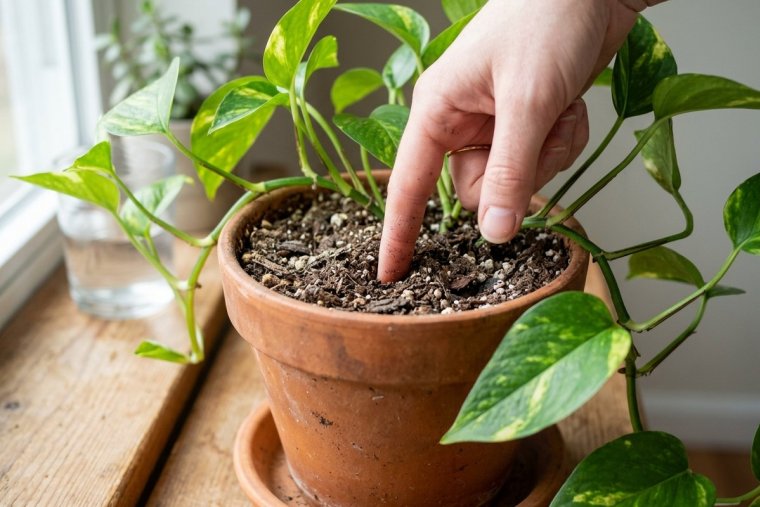
If it is dry at that depth, the plant probably needs water.
If it is still moist, wait a few more days.
Lifting the pot helps too, because a dry pot weighs much less than a wet one.
When you water, let the excess drain freely, then empty the saucer.
The UMD Extension says never to let houseplants sit in water.
Our guide on how to water indoor plants walks through the whole routine.
Step 3: Check the Drainage
A pot that drains slowly stays wet much longer.
- Make sure the pot has a drainage hole and that it is not blocked.
- Do not leave the pot standing in a decorative outer pot full of water.
- Watch whether water soaks in quickly or sits on top of the mix.
The UMD Extension notes that if a finger cannot go two inches deep, the mix may need to be more porous.
It recommends repotting when a pot has poor drainage.
A fresh, fast-draining mix makes a calmer home for roots.
Step 4: Think About Light, Warmth and Air
The UMD Extension notes that humidity and temperature both affect how much water a plant needs.
A pot in a cool, dim corner may stay damp far longer than one by a bright window.
If the plant tolerates more light, a brighter spot can help the mix dry between waterings.
Give pots a little space from each other so air can move around them.
What About Slime Molds?
Sometimes the surprise is not a mushroom at all.
A soft, slimy patch may appear on the soil or on bark, sometimes bright yellow.
The UC program explains that slime molds are not true fungi.
They are primitive organisms that grow in similar places and live on decaying plant material.
They are especially common on mulch.
The UC program notes that undisturbed slime molds usually disappear in a week or so.
Indoors, you can simply scoop the patch out and let the surface dry.
Other Signs of Soil That Stays Too Wet
Mushrooms are not the only clue that a pot stays damp.
- Tiny dark flies around the pots are often fungus gnats.
- Tiny pale specks that jump on the soil are often springtails.
- Leaves that turn yellow while the soil is wet can point to overwatering.
Our guides to fungus gnats, springtails and yellow leaves explain each one.
Fixing the watering often solves several of these at once.
A Calm Checklist
- A mushroom is the fruiting part of a fungus that lives in the mix.
- It usually means the soil stays damp for too long.
- Remove mushrooms right away if children or pets live with you.
- Never taste a mushroom to identify it.
- Call poison control or your veterinarian if one may have been eaten.
- Water by need, empty the saucer and check the drainage.
- Expect a few more to appear until the soil dries out.
A mushroom in a pot is a small mystery with a simple answer.
Pick it out safely, let the soil breathe and water a little less often.
Your plant will carry on, and the surprise visitors will fade away.
Sources and Further Reading
- UC Statewide Integrated Pest Management Program — Pest Notes: Mushrooms and Other Nuisance Fungi in Lawns: supports what mushrooms and mycelium are, how spores spread, why wet conditions trigger them, why picking them does not kill the fungus, the warning about poisonous mushrooms, and the notes on slime molds.
- University of Maryland Extension — Watering Indoor Plants: supports watering by need, the two-inch finger test, the lift test, never leaving pots in water, and repotting pots that drain poorly.
- MedlinePlus (National Library of Medicine) — Poisoning: supports plants as possible poisons and calling poison control at 1-800-222-1222 right away.
- ASPCA Animal Poison Control — Toxic and Non-Toxic Plants: the reference for checking houseplants around cats and dogs and for pet poisoning help.