
A fire extinguisher is one of those things most of us own but rarely think about.
It sits under the sink or in a closet, waiting for a day we hope never comes.
Many adults are not sure which kind to buy or how to use it.
That uncertainty can turn a small kitchen flare-up into a frightening moment.
The good news is that the basics are simple and easy to learn.
This guide covers the types of extinguishers, how to choose one for a home and how to read the label.
It also explains when it is safe to use one, the four steps to remember and how to keep it ready.
Knowing all this ahead of time is what lets you stay calm if you ever need it.
An Extinguisher Is Only Part of the Plan
An extinguisher is a tool for a very small fire.
It does not replace smoke alarms or a plan to get everyone out.
The US Fire Administration notes that extinguishers can save lives and property with proper training and education.
It also points out that fire departments can help with extinguisher training.
In a real emergency, getting out safely always comes first.
Think of the extinguisher as a backup for the rare moment when a fire is tiny and you are not in danger.
The Classes of Fire
Not every fire is the same, and not every extinguisher fights every fire.
Extinguishers contain different agents, such as water, carbon dioxide, dry chemical or wet chemical.
The US Fire Administration describes five main types, each named by a class.
- Class A: ordinary materials such as cloth, wood and paper.
- Class B: flammable liquids such as grease, gasoline, oil and oil-based paints.
- Class C: electrical equipment plugged into an outlet, such as appliances and tools.
- Class D: flammable metals, usually found in factories.
- Class K: cooking oils and fats in commercial kitchens, such as restaurants.
Class C extinguishers use an agent that does not conduct electricity.
Classes A, B and C are the ones most often found in homes.
Why a Multipurpose Extinguisher Suits Most Homes
A home can have all three common kinds of fire in one afternoon.
Paper burns in the living room, grease in the kitchen and wiring in the garage.
The US Fire Administration notes that multipurpose extinguishers can be used on most types of home fires.
These are often labeled "A-B-C" or "B-C".
Most home improvement stores carry multipurpose models that cover Class A through Class C.
For most households, an A-B-C model is the simplest calm choice.
Look for the Testing Label
Quality matters for a safety tool.
The US Fire Administration advises looking for the "UL Listed" or "ULC Listed" label.
This shows that a nationally recognized testing laboratory has certified the extinguisher.
If you cannot find the label on the package or the can, choose another model.
Pick a Size You Can Handle
Extinguishers come in many sizes and weights.
The US Fire Administration recommends choosing the largest one you can safely and comfortably operate.
A bigger extinguisher holds more agent and runs longer.
Yet it only helps if you can lift it, aim it and squeeze the lever without struggling.
Try lifting a few in the store before you buy.
If several adults live in the home, choose one that each of them can manage.
How to Read the Label
The numbers on the label look confusing at first, but they follow a simple pattern.
The US Fire Administration explains it with an example: 1A:10B:C.
- The number before the A stands for multiples of 1.25 gallons of water on ordinary materials.
- The number before the B stands for the size of liquid fire it can handle, in square feet.
- The letter C means it can be used on electrical fires.
So 1A:10B:C equals 1.25 gallons of water on a Class A fire.
It can also handle a Class B fire of up to 10 square feet and is safe on Class C fires.
Higher numbers mean more firefighting power.
Where to Keep It
An extinguisher only helps if you can reach it in a few seconds.
The US Fire Administration lists easy access as the first thing to check.
Make sure nothing blocks it or makes it hard to grab.
Many households keep one in the kitchen, where small fires most often start.
Choose a spot you can reach on your way out of the room, not right beside the stove.
A hallway closet near the bedrooms and the garage are other common spots.
Tell everyone in the home where each extinguisher is kept.
Decide First: Should You Use It at All
This is the most important part of the guide.
The US Fire Administration suggests asking a short list of questions before using an extinguisher.
- Have I alerted others in the building that there is a fire?
- Has someone called the fire department?
- Am I physically able to use a fire extinguisher?
- Is the fire small and contained to one object, such as a pan or a wastebasket?
- Am I safe from the fire's toxic smoke?
- Do I have a clear escape route?
Use the extinguisher only when every answer is yes.
The US Fire Administration also says young children and older adults should not use fire extinguishers.
If you are unsure, or in any other situation, alert others and leave the building.
Then call 911 from a mobile phone or a neighbor's phone.
Remember the Word PASS
The US Fire Administration teaches a simple word for using an extinguisher: PASS.
- Pull the pin. Hold the extinguisher with the nozzle pointing away from you, and release the lock.
- Aim low. Point the extinguisher at the base of the fire.
- Squeeze the lever. Press it slowly and evenly.
- Sweep the nozzle. Move it from side to side.
Aiming at the base matters because that is where the fuel is burning.
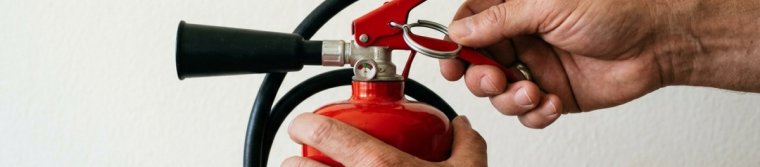
Spraying the flames at the top does far less good.
Keep your back toward a clear exit while you work.
If the fire grows or does not go out quickly, stop and leave.
A Calm Monthly Check
An extinguisher needs a little care to stay ready.
The US Fire Administration lists the main things to look at.
- Easy access: nothing blocks it or limits your reach.
- Pressure: many models have a gauge that shows when pressure is too high or too low.
- Working parts: the can, hose and nozzle are not damaged, dented or rusted.
- Cleanliness: no dust, oil or grease on the outside.
- Instructions: follow the guidelines printed on your model.
Some extinguishers need to be shaken monthly.
Others need pressure testing every few years.
Some can be recharged, while others must be replaced when the pressure drops too low.
Pair this check with your monthly smoke alarm test, so both happen on the same day.
Practice Without Fire
Reading about PASS is helpful, but practice builds calm.
Take the extinguisher down and hold it for a moment without pulling the pin.
Find the pin, the lever and the nozzle with your hands.
Say the four steps out loud while you go through the motions.
Ask your local fire department whether it offers hands-on training.
Many communities run free sessions where you can practice with a real extinguisher.
Pair It With an Escape Plan
Even the best extinguisher cannot replace a way out.
The National Fire Protection Association encourages every household to plan how to get out of each room.
Agree on a meeting spot outside, such as a mailbox or a neighbor's tree.
Practice the plan together once or twice a year, slowly and in daylight.
With a plan in place, the extinguisher becomes one calm option rather than the only one.
A Gentle Way to Begin
You can take care of this in a single afternoon.
First, check whether you already own an extinguisher, and read its label.
If you do not have one, buy a multipurpose A-B-C model with a UL label.
Choose a spot near the kitchen exit and show everyone where it is.
Practice the PASS motions once, without pulling the pin.
Then add the monthly check to the same reminder as your smoke alarm test.
Sources and Further Reading
- US Fire Administration: Choosing and Using Fire Extinguishers — classes of fire, multipurpose extinguishers, the UL label, reading the label, when to use one, the PASS steps and maintenance checks.
- National Fire Protection Association: Escape Planning — planning ways out of every room and practicing the plan.